

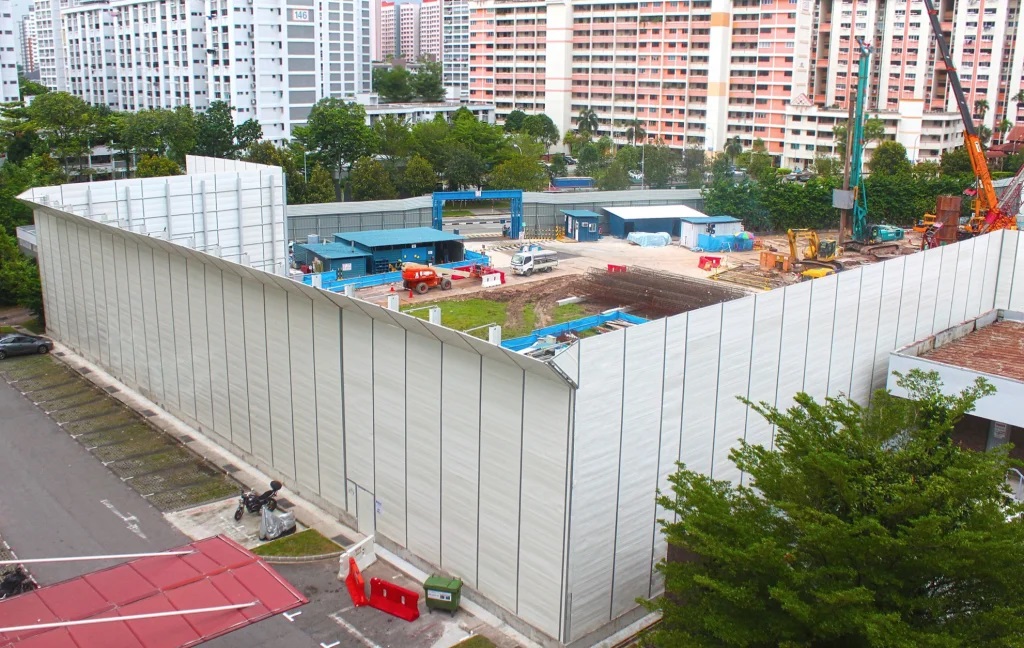
Urban development in Singapore is characterised by dense residential clusters, tight sites, and high‑rise structures. With new construction all around, noise control has emerged as a serious issue. One of the ways developers are responding is through widespread adoption of the noise barriers in Singapore.
Let’s look at why these solutions are becoming the norm rather than the exception.
1. Stringent Regulatory Environment
Singapore’s principal noise‑control body, the National Environment Agency (NEA), has set out clear rules for construction‑site noise. For example:
- Construction work near residential buildings must not exceed defined noise levels — e.g., 75 dBA (Leq 12 hrs) for residential buildings less than 150 m from the site during 7 a.m.–7 p.m. on weekdays.
- Work on Sundays/public holidays is restricted for sites within 150 m of residential/noise‑sensitive premises unless a special permit is obtained.
- Starting 1 April 2025, all new projects worth S$50 million or more and situated within 75 metres of sensitive sites are required to have perimeter noise barriers at least six metres high, featuring acoustic‑absorbing materials and meeting a specified sound‑transmission class (STC) standard.
- These requirements push developers and contractors to integrate noise‑mitigation measures early on. Installing a noise barrier is now often part of the compliance checklist.
2. High Urban Density and Close Proximity
In Singapore, construction sites often neighbour housing estates, schools, hospitals and commercial zones. The proximity makes noise‑impact risks much higher than in less dense settings. Residents or businesses near sites may complain, raising potential for delays, reputational problems or even enforcement actions.
As NEA points out in reader‑letters, noise‑barrier systems “are often one of the measures…and should be checked for effectiveness” to avoid exceeding limits. Because the stakes are high for disturbance, noise-controlled construction is not just desirable — practically required.
3. Community Relations and Public Expectations
With so many people living and working close to construction sites, the expectation for minimal disruption has grown. Developers understand that good public relations matter, especially in a market like Singapore where projects are highly visible.
When construction noise is well‑managed, including through visible noise barriers, it signals that the developer is considerate of the surrounding community. This can help obtain smoother approvals, avoid formal complaints and foster goodwill. For example, the Land Transport Authority (LTA) cited public feedback when explaining its installation of more noise barriers at infrastructure works.
- Technical Advances and Proven Results
Noise barrier technology in Singapore has matured. There are steel‑panel noise barrier sheets, modular systems, and acoustic barriers with tested performance. For example, one manufacturer reports compliance with new NEA perimeter barrier requirements and sound‑transmission class ratings of STC 27 for their panels.
Earlier work by LTA in collaboration with the National University of Singapore achieved noise reductions of up to 30% for construction sites using specialised barrier designs.
These technical improvements make noise barrier solutions more reliable and accepted — they are no longer a “nice‑to‑have” but a trusted method.
5. Financial Incentives and Industry Support
The government has programmes that help steer the industry towards less noisy construction practices.
One example is the Quieter Construction Innovation Fund (QCIF) set up by NEA to support innovation in noise‑mitigation solutions.
When using noise barrier solutions becomes financially viable (or developer risk of non‑compliance becomes costly), the uptake naturally increases.
6. Standardisation of Best Practice
With regulations, technical solutions and industry expectations all aligning, the use of noise barrier solutions in Singapore is becoming standard practice. One industry website even states:
“Now it is something that we see as an essential need in every project, no matter how large or small … environmental noise compliance and keeping within the maximum permissible noise levels is a standard that all parties must comply with.”
This kind of language shows that using a noise barrier is no longer exceptional — it is “standard”.
7. Risk Management and Reputation Protection
Projects that neglect noise‑control risk complaints, delays, fines, or being forced to alter work hours. For developers and contractors in Singapore, who rely on efficient timelines and stakeholder goodwill, these risks are significant. Using noise barrier solutions is thus part of risk management.
With stricter enforcement and public visibility, managing noise is not simply about compliance but about protecting project reputation and timelines.
8. Sustainability and Liveability Considerations
Singapore’s planning philosophy emphasises liveability and sustainable urban environments. Noise pollution is increasingly recognised as part of environmental quality. The use of noise barriers supports the wider policy objective of creating a pleasant, safe and sustainable urban environment for residents, even when construction is ongoing.
In that sense, noise barrier solutions tie into broader urban‑planning and sustainability frameworks.
Conclusion
The adoption of noise barrier solutions in Singapore is the result of a confluence of factors: strong regulation, dense urban form, community expectations, technical maturity, financial support and reputational risk. Once seen as an optional extra, noise barriers now form a standard toolkit in many construction projects in Singapore.
If you’re involved in development or construction in Singapore, incorporating a robust noise‑barrier approach is no longer just best practice, but an increasingly essential requirement for success.